


After Bitget obtained hacked on Sept. 24, $387.5 million of stolen funds rapidly began transferring across chains, with some headed to decentralized spoiled chain swaps platform THORChain.
Chief govt Gracy Chen publicly appealed to the platform to refuse carrier to attacker-linked addresses. “The industry is gazing,” she acknowledged.
Yet THORChain refused. And that refusal has kicked off a angry debate between these who imagine protocols have a legit obligation to dam stolen funds, and these protect the cypherpunk beliefs of decentralized, permissionless skills sacrosanct.
Having previously watched on because the Bybit hackers funneled $1.2 billion by the protocol, it’s somewhat particular which aspect of the argument THORChain is on. Protocol contributor Boone Wheeler tells Magazine:
“A genuinely permissionless protocol can create nothing when it encounters diagnosed stolen funds — it’s blind to their provenance. If THORChain were ready to dam particular stolen funds, it wouldn’t be permissionless.”
Where does permissionlessness halt?
Critics argue that THORChain wasn’t somewhat so idealistic when validators voted to halt the chain in Can also after an automatic system triggered when an attacker exploited a vulnerability and drained over $10 million from one in every of its vaults.
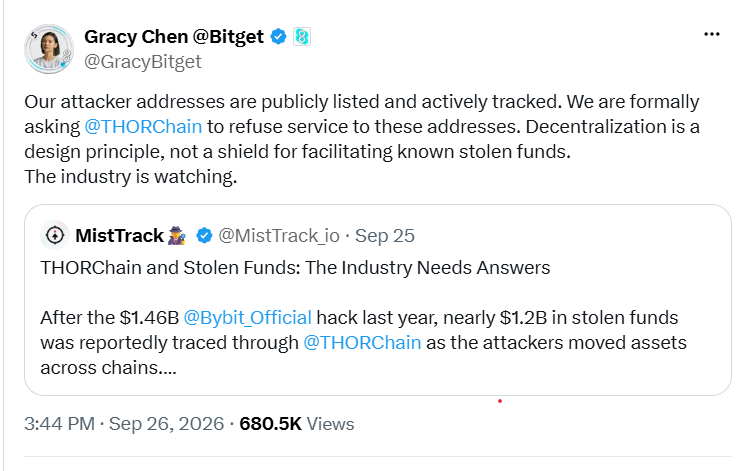
Bitget CEO argues THORChain must refuse services. Source: Gracy Chen
NEAR Intents, which is a spoiled-chain transaction competitor of THORChain, took the reverse procedure and intervened to dam hack-linked funds. Its automated security layer SHIELD diagnosed bigger than $50 million in attempted flows linked to the Bitget incident and stopped $503,000 for the interval of execution. It acknowledged $166,000 handed by.
Associated: THORChain under fire over Bitget, ETH evolves beyond blockchain: Hodler’s Digest
NEAR also waived its half of Bitget’s recovery bounty. Fundamental supervisor Alex Shevchenko tells Magazine, “NEAR Protocol is permissionless: anybody can fabricate on it, transact on it, and switch out to be a validator…
“No person wants permission to protect or transfer sources or deploy contracts on NEAR Protocol. However, that does not imply every software built on NEAR must direction of every quiz.”
NEAR Intents has since arrive under heavy fire for intervening, with critics arguing it demonstrates it’s no longer permissionless or decentralized. This may well well show it to claims it must allege that protect watch over more broadly. However, because SHIELD is an automatic system, crypto lawyer Yuriy Brisov believes it would perhaps well smooth tumble for the interval of the protections afforded to decentralized protocols.
“There isn’t any longer any compliance crew, of us that take a seat there and protect watch over the operation manually. Right here’s a neat resolution, and that’s what we imply to the total DeFi corporations.”
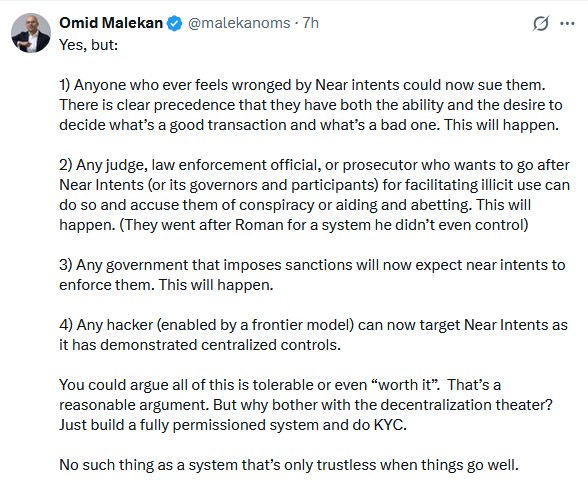
Source: Omid Malekan
Permissionless doesn’t necessarily mean neutral
Biget’s Chen tells Magazine that whereas she understands varied protocols have “varied architectures, governance models and technical capabilities,” there could be a first-rate distinction between permissionless infrastructure and “facilitating the movement of diagnosed stolen funds.”
She points to NEAR Intents’ actions and says, “We be pleased that response and would perhaps well be aware the supreme legal and recovery direction of for these sources.”
Bitget wants to absorb “what’s technically and governance-knowing that you just would also imagine when stolen sources are diagnosed,” Chen says, and whether the industry can accumulate workable approaches collectively:
“Permissionless infrastructure doesn’t necessarily mean there would perhaps be no mechanisms for detecting and responding to diagnosed illicit flows.”
Complicating THORChain’s argument, it has shown it’ll intervene in an emergency if it chooses to.
THORChain’s submit-mortem of the Can also exploit acknowledged the protocol robotically halts job when its solvency checks detect an insolvency tournament, and node operators can then employ broader emergency controls to pause trading, signing and varied network job.
Associated: SlowMist traces Bitget hack job to Aug. 31 zero-day exploit
Wheeler says there is “firm consensus” amongst THORChain’s nodes around the easier of being permissionless, and that “halts are supreme historical when there is an brisk allege or allege with the protocol.”
Furthermore, he says there is “no functionality to cloak individual addresses or transactions.” Right here’s a create different, because the system turned into once “intentionally designed to be genuinely permissionless.”
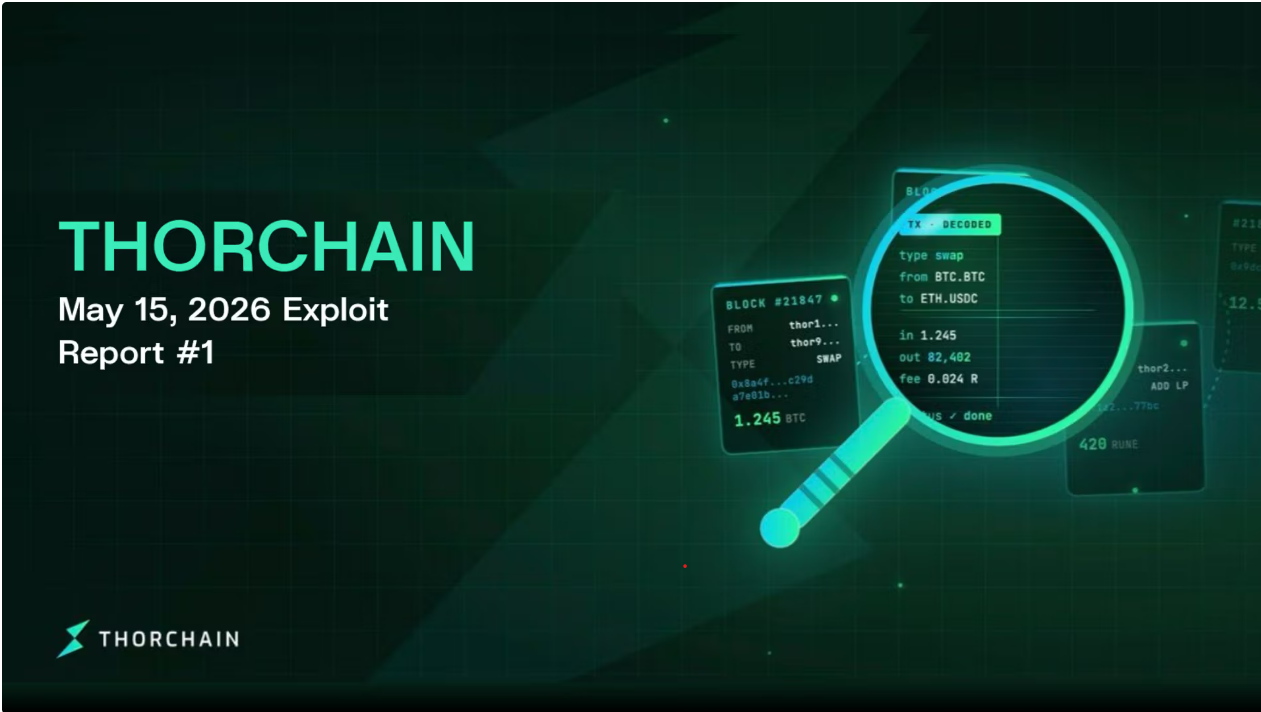
THORChain halted its chain in Can also over a security incident. Source: THORChain
NEAR Intents affords a contrasting model
Whereas THORChain is found on the dark big-coder halt of the spectrum, the NEAR crew occupies the center floor. NEAR has a brand current ETF from Bitwise and has an even philosophy and procedure.
Shevchenko says NEAR Intents turned into once designed to enable commence participation but has its have monetary integrity measures, and SHIELD is built to “robotically be aware targeted controls to supported flows.”
In this incident, he says SHIELD historical public onchain files and alerts from an within anti-cash laundering (AML) database and third-get collectively intelligence suppliers, equivalent to those listed in the NEAR Intents risk and compliance doctors.
“SHIELD no longer supreme protects NEAR Intents however the full spoiled-chain ecosystem it serves,” Shevchenko says:
“Each considerable hack drains capital and job from the onchain economy, so screening for stolen funds and restricting cash laundering helps provide protection to the integrity of the broader blockchain economy.”
Actually, the AI-based SHIELD diagnosed the suspicious habits slack Thursday’s $3.8 million Omni deposit/withdrawal interplay exploit, and halted job.
Chen says when stolen funds would perhaps be reliably diagnosed, ecosystem contributors “must cooperate where technically and legally that you just would also imagine.”
That also can mean tracing and data sharing, declining transactions, freezing sources where the infrastructure enables it, or “supporting recovery by the supreme legal and law enforcement processes.”
The price of drawing the road
Joël Valenzuela, a libertarian, cypherpunk and head of business and trend for Crawl, argues that permissionless formulation exactly that.
“Permissionless protocols, somewhat frankly, must no longer procedure the road anywhere when stolen funds are diagnosed, because being ready to create so the least bit makes them permissioned.”
He says that, as “painful” because it’s to behold stolen funds freely moved, the flexibility to step in and forestall this “opens up Pandora’s Box” and “lets all formulation of censorship of innocents at closing occur.” As a change, centralized exchanges must harden security protocols, he says:
“High-level exchanges custodying billions of bucks must clutch their security a long way more seriously. In the slay, DEXs are the formulation ahead.”
Max Shannon, senior evaluate affiliate at Bitwise Europe, says that protocols smooth in their formative years, be pleased THORChain and NEAR, smooth must design belief and that refusing to launder hack proceeds is a “sound stance.”
He believes THORChain’s actions will most likely lead to additional cash laundering flows shifting from NEAR Intents to THORChain.
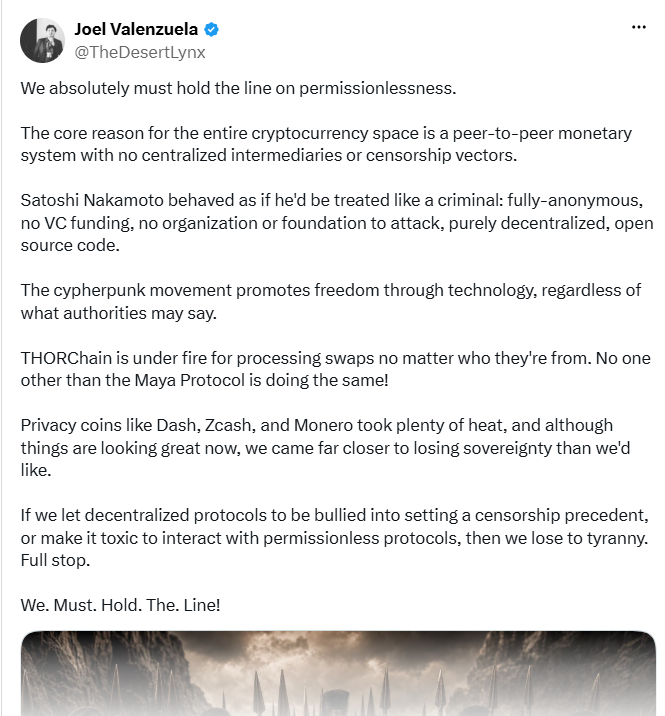
Valenzuela argues we must protect the road on permissionlessness. Source: Joël Valenzuela
“Credible neutrality the least bit prices,” Shannon says, is a “cypherpunk ideal” that a little faction of crypto users and builders smooth champion.
“They hardly ever ever depend on why it’s helpful, when it’s helpful, or what it prices,” he says. “Right here’s the core distinction between NEAR Intents and THORChain.”
Magazine: Altseason is coming — and traders are more discerning this time
