

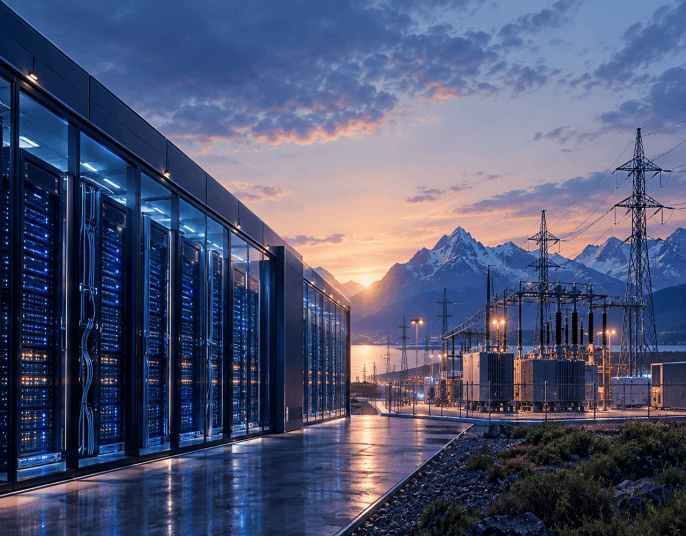
Clichmont is positioning itself as an owner and operator of AI infrastructure rather than simply a renter of GPU capacity, arguing that electricity, cooling and connectivity could become more decisive constraints than access to chips.
CEO Alexis Cathalifaud said the company’s strategy is based on controlling the physical systems needed to deploy successive generations of accelerated computing hardware. The approach differs from providers such as CoreWeave, Crusoe and Lambda, whose businesses are more closely associated with supplying rented GPU capacity.
Beyond the GPU race
According to Cathalifaud, renting GPUs provides access to computing power but leaves customers exposed to a provider’s pricing, availability, deployment schedules, energy limitations and network design. Owning or controlling data-center infrastructure could give Clichmont greater influence over how hardware is installed, cooled, upgraded and commercialized.
The company’s thesis is that GPUs can lose economic value relatively quickly as newer generations arrive, while land, grid connections, substations, cooling systems, fiber links and permitted power capacity may remain useful across multiple hardware cycles. In that view, the scarce asset is not only the accelerator itself, but the ability to operate large numbers of them reliably and economically.
Cathalifaud said securing 10,000 GPUs would not solve the infrastructure problem if the operator lacked the tens of megawatts of electricity, cooling and networking capacity required to run them. Power availability is therefore central to how Clichmont evaluates potential locations.
Power determines where facilities can be built
Clichmont says it assesses sites according to the full infrastructure equation rather than focusing solely on the price of land. Key considerations include the amount and reliability of available electricity, the time required to connect to the grid, cooling conditions, fiber connectivity, permitting, security and the ability to expand.
The company has identified projects in Alicante, Spain, and Bodø, Norway, as examples of different infrastructure approaches. Bodø offers a cooler climate and access to a strong power environment, while Alicante provides a different energy profile and the possibility of incorporating solar generation into the facility design.
For Clichmont, a low-cost parcel without scalable electricity or adequate connectivity is not necessarily a viable data-center location. The company says its objective is to find sites where energy, cooling, connectivity and expansion potential can work together.
Physical infrastructure brings a different execution risk
Scaling data centers also introduces constraints that do not exist in the same way for software companies. Each additional megawatt can depend on grid capacity, transformers, switchgear, cooling equipment, fiber, construction and permits. A delay in any one component can postpone an entire deployment.
Capital decisions must also be made years before the relevant hardware cycle is fully known. Building too early could leave Clichmont with underused infrastructure, while moving too slowly could cause customers to choose another provider. Cathalifaud described the central challenge as coordinating capital, power, construction and demand so that they become available at roughly the same time.
That model carries a significant risk: infrastructure built in the wrong location, at the wrong scale or for the wrong timing is difficult and expensive to reverse. A software system can be modified quickly, but a large electrical or cooling installation cannot be redesigned overnight.
Clichmont’s token remains a separate test
Clichmont also has a digital asset, $CLAI, linked to the broader ecosystem. Cathalifaud acknowledged that skepticism is reasonable when a physical infrastructure company introduces a token.
He said $CLAI is intended to serve as a digital financial layer that could support on-chain participation, treasury activity and community governance. However, he argued that the token should not be treated simply as a financing wrapper for the company’s data centers. The physical infrastructure, he said, must be able to exist independently of the token, while the token must demonstrate measurable utility beyond speculation.
That distinction leaves the token’s value proposition dependent on whether Clichmont can develop practical functions for it that would not be as effectively handled through a conventional corporate or database structure.
A focused European operator rather than a hyperscaler
Clichmont does not expect to match the scale of larger AI infrastructure companies such as CoreWeave or Nebius within three years. Instead, Cathalifaud said the company wants to become a recognized, efficient AI infrastructure operator in Europe, with secured power, high-density GPU capacity and a track record of bringing new compute online quickly.
The company also aims to serve AI, high-performance computing and private compute workloads rather than compete solely on the volume of GPU rentals. Its longer-term bet is that control of power, cooling and data-center capacity will become increasingly valuable as demand for AI computing expands.
That strategy offers greater control over the underlying infrastructure but requires substantial capital, long planning horizons and disciplined execution. Clichmont’s progress will ultimately depend on whether it can secure suitable sites, bring capacity online on schedule and keep its facilities economically useful as GPU technology changes.
