

Naoris Protocol has launched its mainnet, introducing a layer-1 blockchain designed to exercise submit-quantum cryptography for transaction validation and network security. The network is are residing with restricted, invite-supreme participation, allowing early customers to speed validator nodes and direction of transactions.
In step with an announcement shared with Cointelegraph, it integrates cryptographic requirements finalized by the National Institute of Requirements and Technology (NIST) to address dangers in present blockchains, the put fresh encryption ideas would perhaps develop into inclined over time.
Sooner than mainnet, the protocol’s take a look at network processed higher than 100 million transactions and flagged what it described as a form of of hundreds and hundreds of doable security occasions.
The plot makes exercise of a consensus model called dispensed proof of security (dPoSec) to verify transactions all over nodes, whereas the NAORIS token is supposed to spice up network operations as the economic model develops.
The rollout begins with a restricted community of validators and partners, with broader get entry to expected to amplify in phases.
The project lists advisers with backgrounds in cybersecurity, government and conducting expertise, and is backed by traders including Draper Pals.
Related: Is $450B in Bitcoin inclined to the quantum threat? Analysts weigh in
Novel examine suggests quantum computing would perhaps come sooner than expected
The begin comes as revised estimates for quantum computing, which makes exercise of qubits and quantum states to direction of recordsdata differently from classical computers, are driving efforts to transfer some distance from fresh cryptographic requirements.
Novel examine from Google launched on Monday suggests quantum computers would perhaps possess some distance fewer resources than beforehand idea to interrupt blockchain encryption. The gaze found fewer than 500,000 bodily qubits would perhaps crack programs securing Bitcoin (BTC) and Ether (ETH), a roughly 20-fold good deal from earlier estimates.
The findings existing a shorter timeline for quantum danger, with Justin Drake, a researcher at the Ethereum Foundation, estimating at the least a 10% chance that a quantum computer would perhaps enhance a non-public key by 2032.
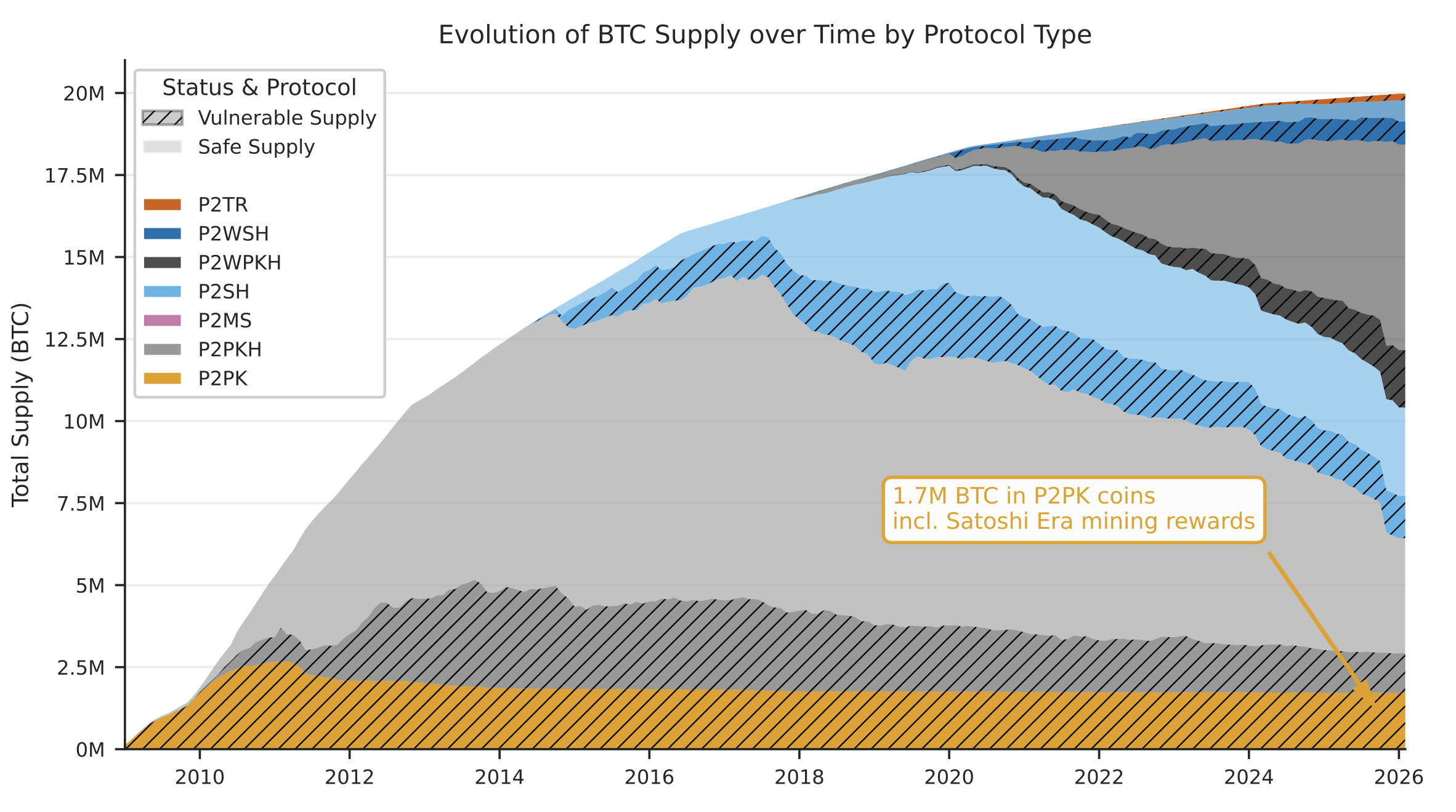
Breakdown of Bitcoin present by take care of kind and quantum exposure danger. Source: Google Quantum AI
Researchers at California Institute of Technology working with Oratomic reached an identical conclusions, no longer too prolonged within the past finding that enhancements in error correction (which decrease the artificial of qubits needed to stabilize computations) would perhaps lower the requirements for shimmering programs to 10,000 to 20,000 qubits, down from earlier assumptions of hundreds and hundreds.
In step with these reductions, the researchers mentioned a viable quantum computer would perhaps emerge by around 2030.
Blockchain builders are starting up to reply. In January, builders within the Solana ecosystem launched a quantum-resistant vault that makes exercise of hash-essentially based signatures to generate unique keys for every transaction, reducing the exposure of public keys.
On March 24, builders from the Ethereum Foundation launched a “Put up-Quantum Ethereum” helpful resource hub outlining plans to enhance the network’s cryptography, focusing on protocol-diploma adjustments by 2029 whereas moreover noting the multi-year complexity of this kind of transition.
Magazine: A beginner’s recordsdata to surviving crypto winter
Cointelegraph is dedicated to independent, clear journalism. This recordsdata article is produced in accordance with Cointelegraph’s Editorial Coverage and aims to kind true and neatly timed recordsdata. Readers are encouraged to verify recordsdata independently.
